
I have a confession to make: I spent three years of my life hating every single fuel can I owned.
It started when the old-school “vented” cans were phased out in favor of the modern EPA-mandated “safety” spouts. Suddenly, a task as simple as refueling a lawnmower became an Olympic event in frustration. I dealt with spring-loaded nozzles that required three hands to operate, “no-spill” valves that leaked all over my boots, and plastic containers that bloated in the summer sun until they looked like they were about to achieve orbit.
By 2026, I had finally had enough. I decided to treat my garage like a laboratory. I bought five different types of fuel containers, from the $15 hardware store special to the $100 military-grade steel canisters, and put them through a rigorous “real-world” test. I measured pour speeds, checked for vapor leaks, and dropped them (full) from the back of my truck.
If you are tired of gas station spills and struggling with stubborn spouts, here is my hard-won guide to which fuel can actually work and which ones belong in the recycling bin.
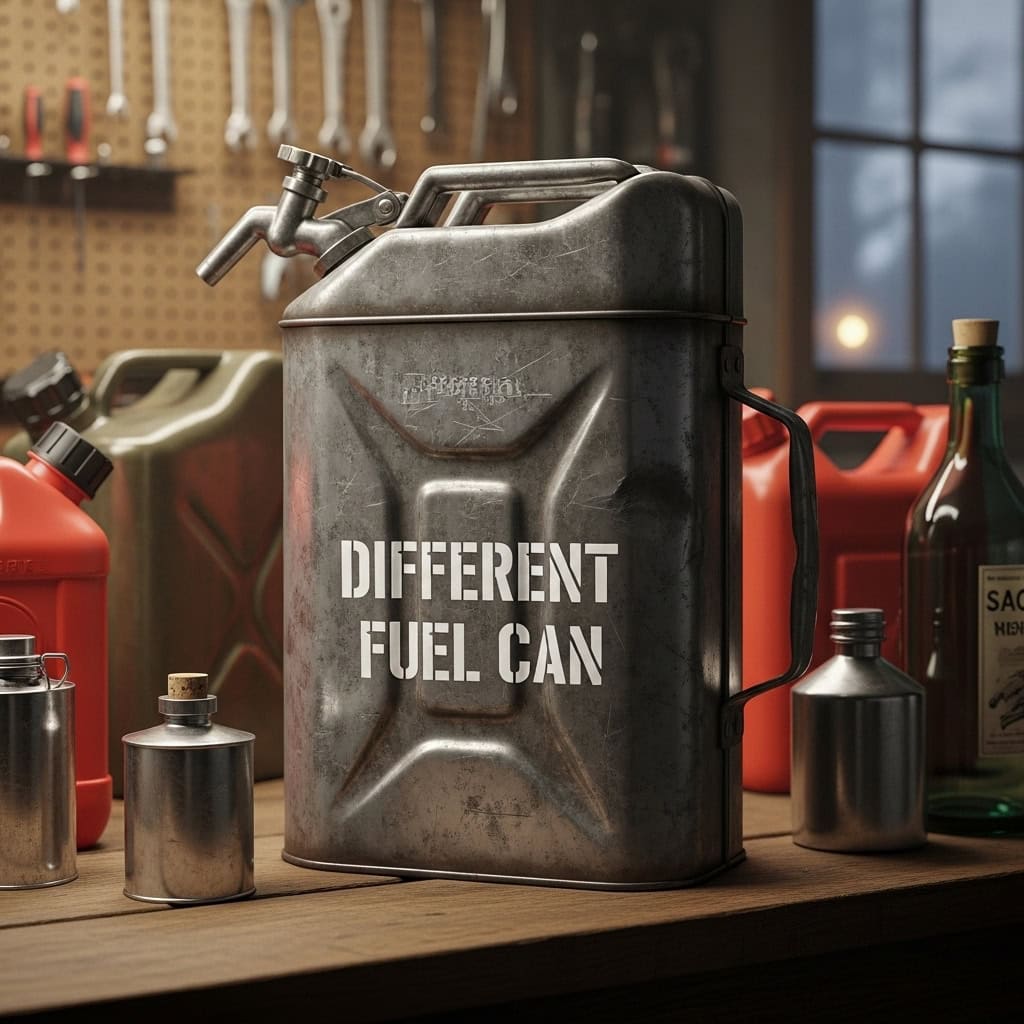
The Anatomy of a Fuel Can: Why They Fail
Before we get into the reviews, we have to understand the science of why a fuel can is actually a very difficult piece of equipment to design. Gasoline is a volatile cocktail of hydrocarbons. It wants to do two things: evaporate and expand.
The Material Science
Most portable cans are made of HDPE (High-Density Polyethylene). While HDPE is durable and doesn’t rust, it is actually “porous” on a microscopic level. Over time, gasoline vapors can permeate through the plastic walls. This is why an old plastic gas can often smells like fuel even when it’s empty and closed.
Steel cans, on the other hand, are truly airtight. However, they face the enemy of moisture: rust. In 2026, the best steel cans use internal linings (like Plascoat) to prevent the fuel from reacting with the metal.
The Physics of the “Glug”
The reason those old-fashioned cans had a little yellow vent cap on the back was to prevent the “glug-glug” effect. When fuel leaves the can, a vacuum is created. Without a vent to let air in, the air has to fight its way in through the same hole the gas is coming out of.
The relationship between flow rate ($Q$), volume ($V$), and time ($t$) is simple:
$$Q = \frac{V}{t}$$
But when you add “slug flow” (the glugging), the flow rate becomes inconsistent and prone to splashing. Modern “safety” cans try to solve this with internal venting, but as we’ll see, some do it better than others.
Category 1: The “Hardware Store” Plastic Can (The Scepter/Briggs Style)
We’ve all owned these. They are red, they are plastic, and they usually come with a black spout that has a sliding lock mechanism.
- The Test: I tried to fill a 5-gallon generator using this can.
- The Experience: It was miserable. To get the fuel to flow, you have to hook the “lip” of the spout onto the tank and push down with significant force. The spring is so stiff that if your hand slips, the spout snaps shut, causing a “pressure spike” that sprays gasoline back out of the tank and onto your shirt.
- The Verdict: Avoid for large jobs. These are “fine” for a small 1-gallon can for a weed-whacker, but for anything over 2 gallons, the weight of the can makes the safety mechanism nearly impossible to use safely.
Category 2: The “No-Spill” Push-Button Can
This is a step up in the plastic world. Brands like No-Spill use a green thumb button to control the flow.
- The Test: Refueling a lawn tractor on a slight incline.
- The Experience: This was a revelation compared to the standard safety spout. You can tip the can completely upside down, insert the nozzle into the tank, and then press the button. The flow is fast, and the second you release the button, the fuel stops. No drips.
- The Verdict: The Best Value. If you want to stay with plastic, this is the only design worth owning. It handles the “glug” issue with an internal vent tube that actually works.
Category 3: The “Jerry Can” (The Military Gold Standard)
I’m talking about the authentic Wavian Steel Jerry Can. These are based on the original 1930s German design, and there is a reason they haven’t changed in nearly a century.
- The Test: A “Drop Test” (full) from 4 feet onto concrete, followed by a 100-mile drive in a hot truck bed.
- The Experience: The bayonet-style closure is 100% airtight. I left this can in the back of my truck in 90°F heat; unlike the plastic cans, it didn’t bloat or “balloon.” The pour spout is a separate attachment that breathes perfectly.
- The Verdict: The Professional’s Choice. It is heavy (about 9 lbs empty), and it is expensive (around $85–$100), but it will last 30 years. It’s the only can I trust for long-term fuel storage.
Category 4: The Utility Jug (The “Race” Style)
You’ve seen these at motocross tracks—tall, square, often with a long clear hose. Brands like VP Racing or LC2 dominate this space.
- The Test: High-speed refueling of an off-road vehicle.
- The Experience: These cans are not technically “EPA-approved” for fuel transport on public roads (they are often labeled as “Utility Jugs”), but they are the fastest-pouring containers on Earth. They have a massive vent cap on the back. You can empty 5 gallons in under 45 seconds.
- The Verdict: Best for Off-Road/Private Property. If you are refueling a boat at a dock or a dirt bike in your yard, the ease of the long hose is unbeatable. Just be aware of the legal labeling in your state.
Comparison Table: Which Fuel Can Wins?
| Feature | Plastic “Safety” Can | No-Spill Button | Steel Jerry Can | Utility Jug |
| Pour Speed | Slow / Erratic | Medium | Fast | Blazing Fast |
| Spill Risk | High | Very Low | Low | Medium |
| Durability | Medium (Bloats) | Medium | Extreme | High |
| Airted/Sealed | No (Vents Vapors) | Better | Perfect | No (Must vent) |
| Best Use | Emergencies only | Lawn & Garden | Long-term/Overland | Racing/Boating |
Pro-Tips for Fuel Storage in 2026
No matter which fuel can you choose, the fuel inside is only as good as how you treat it.
The Thermal Expansion Problem
Gasoline expands significantly with temperature. If you fill a can to the very brim on a cool morning and leave it in the sun, the pressure increase can be calculated using the coefficient of thermal expansion ($\beta$):
$$\Delta V = V_0 \cdot \beta \cdot \Delta T$$
For gasoline, $\beta$ is approximately $0.00095$ per degree Celsius. A 20-degree rise in temperature can cause 5 gallons of gas to expand by nearly a cup. Always leave at least 5% “headspace” at the top of your can for vapor expansion.
Static Electricity: The Silent Killer
Never fill a fuel can while it is sitting in the bed of a truck with a plastic liner or on a plastic car mat. The friction of the fuel flowing into the can can build up a static charge. If that charge jumps to the pump nozzle, you get a fire. Always place the can on the ground before filling.
Fuel Stability
Modern pump gas (E10 or E15 ethanol blends) starts to degrade in as little as 30 days. The ethanol absorbs moisture from the air, leading to “phase separation.”
- The Habit: If you are storing fuel in a Jerry Can for more than a month, add a high-quality stabilizer like STA-BIL 360. In a sealed steel can with a stabilizer, your fuel can stay fresh for 12 to 24 months.
Final Recommendations: My “Dream Garage” Setup
After all my testing, I cleared out the clutter and settled on a three-can system:
- For the Mower: Two 5-gallon No-Spill plastic cans. They are light enough for my spouse to use and the button control means we never overfill the small tanks on our yard tools.
- For the Generator (Emergency): Three Wavian Steel Jerry Cans. I keep these filled with ethanol-free gas and stabilizer. I know that if the power goes out in two years, that gas will be as fresh as the day I bought it.
- For the Fun Stuff: One VP Racing Utility Jug for the jet ski. The long hose makes it easy to refuel while the ski is bobbing in the water.
Conclusion
A cheap fuel can is a false economy. Between the spilled gas, the ruined clothes, and the frustration of a broken plastic spout, you’ll end up spending more in the long run.
If you want the absolute best experience, buy a steel Jerry Can. If you want the best “bang for your buck,” get a No-Spill plastic can. Throw the rest away, your sanity (and your boots) will thank you.
Leave a Reply