
It was a Tuesday afternoon in the middle of the 2026 summer heatwave when I smelled it, that sharp, unmistakable scent of raw gasoline wafting through the vents of my vintage restomod. I pulled over immediately, popped the hood, and saw a sight that made my blood run cold. A tiny, misty spray of fuel was gushing out from a hairline crack in the fuel hose connecting the rail to the pressure regulator. It was spraying directly toward the hot alternator.
In that moment, I wasn’t just looking at a mechanical failure; I was looking at a potential $20,000 bonfire.
I had built this engine myself. I had obsessed over the forged pistons, the ceramic-coated headers, and the precision-mapped ECU. But when it came to the fuel delivery, I had made a “rookie” mistake: I had grabbed a length of “universal” rubber hose from the bottom of a bin at a local parts store, assuming that as long as it was the right diameter, it was the right tool for the job.
I was wrong. Choosing the right fuel hose eventually saved my engine from a catastrophic fire, but the journey to learning why that specific hose failed taught me everything I needed to know about modern chemistry, engineering standards, and the hidden dangers of the “universal” label.
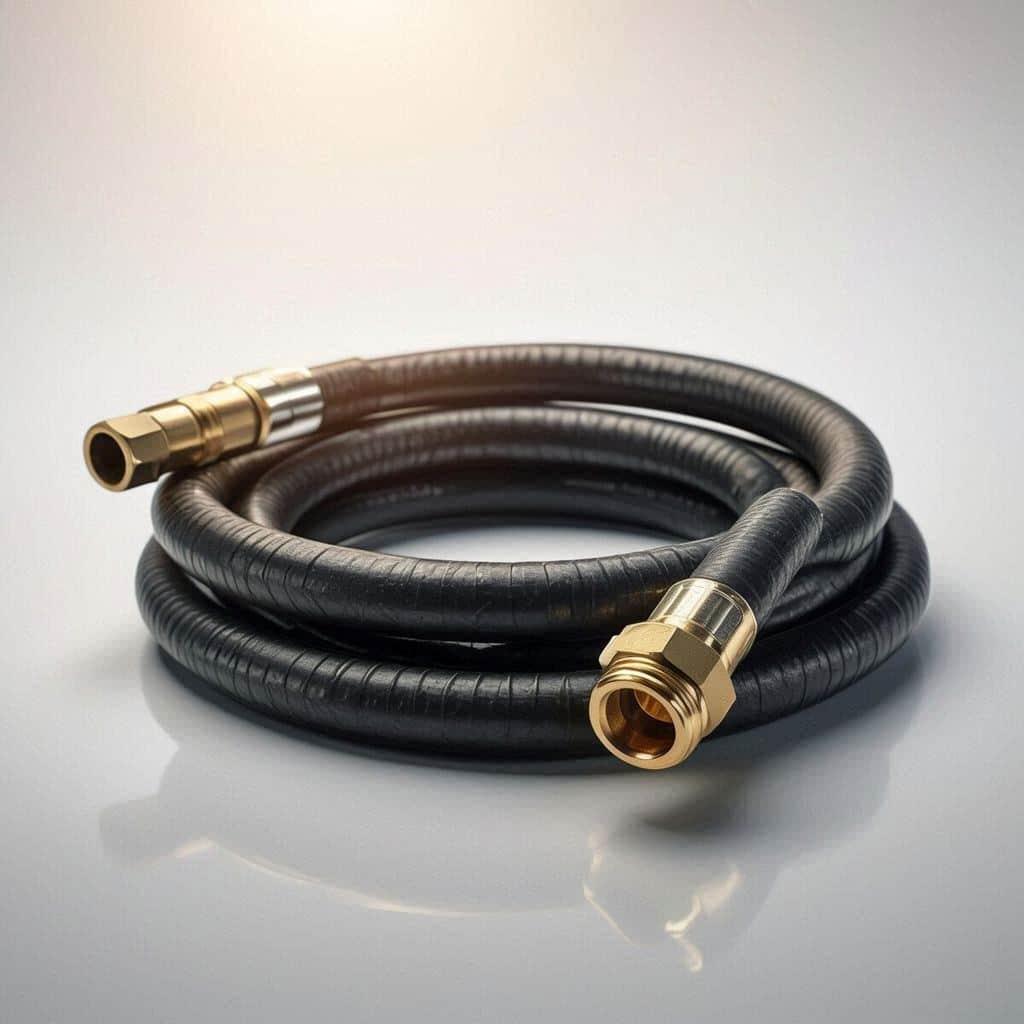
The Chemistry of Failure: Why Old Rubber Dies
To understand why your fuel hose matters, you have to understand how fuel has changed. In 2026, we aren’t just pumping pure petroleum anymore. Most modern pump gas contains up to 10% or 15% Ethanol ($C_2H_5OH$), and specialty fuels like E85 are more popular than ever for performance builds.
The Ethanol Problem
Ethanol is an alcohol, and alcohol is a powerful solvent. Traditional fuel hoses made of Nitrile (NBR) or Neoprene were designed to handle pure hydrocarbons. When ethanol sits in these older hoses, it performs a process called “extraction.” It literally sucks the plasticizers—the chemicals that keep the rubber flexible—out of the hose.
- The Result: The hose becomes brittle on the inside.
- The Danger: From the outside, the hose looks fine. But inside, the lining is cracking and “sloughing off.” These tiny black flakes of degraded rubber then travel downstream, clogging your expensive fuel injectors and causing “lean” conditions that can melt a piston in seconds.
Sour Gas and Permeation
It isn’t just the liquid that’s the problem; it’s the vapor. Older hoses are “permeable,” meaning fuel vapors actually seep through the walls of the hose on a microscopic level. This is why some older garages always smell faintly of gas. In a hot 2026 summer, this vapor loss doesn’t just waste money—it creates an explosive environment under your hood.
Decoding the Language of Hoses: SAE J30 Ratings
When you go to buy a fuel hose, you will see a series of codes printed on the side. These aren’t just serial numbers; they are the “Society of Automotive Engineers” (SAE) ratings. Understanding these is the difference between a reliable engine and a disaster.
SAE J30R6 and J30R7 (The “Danger Zone”)
These are the most common hoses found in big-box auto stores. They are designed for low-pressure, carbureted engines.
- Maximum Pressure: Usually rated for only 50 PSI.
- The Risk: Most modern fuel-injected engines operate at a constant pressure ($P$) of:$$P \approx 45 \text{ to } 65 \text{ PSI}$$
- The Takeaway: Using an R6 or R7 hose on a fuel-injected car is a recipe for a burst line. They also have poor resistance to high-ethanol blends.
SAE J30R9 (The Gold Standard)
If you are doing a repair on any fuel-injected vehicle, R9 is the minimum. It features a fluoroelastomer (FKM) inner lining that is nearly impervious to ethanol and chemical degradation.
- Pressure Rating: Up to 100 PSI or higher.
- Permeation: It has extremely low “fuel-loss” ratings, keeping your garage smelling clean.
SAE J30R12 and J30R14 (The Bio-Fuel Specialists)
These are high-end hoses designed specifically for E85 and biodiesel. They often feature a “barrier” layer (like PTFE or Teflon) that makes them chemically inert. If you are running a high-performance E85 tune, don’t even look at an R9; go straight to an R14-rated hose.
Comparison Table: Which Fuel Hose Do You Need?
| SAE Rating | Best For… | Max PSI | Ethanol Compatibility |
| J30R6 | Lawnmowers / Vintage Carbs | < 50 | Poor (E5 Max) |
| J30R7 | Low-Pressure Fuel Returns | 50 | Moderate |
| J30R9 | Modern Fuel Injection | 100+ | Excellent (E15) |
| J30R10 | Submersible Use (Inside the tank) | 100 | Excellent |
| J30R14 | E85 / Racing Fuels | 200+ | Superior |
The “Submersible” Trap: A $1,000 Mistake
This is the mistake that almost cost me a fuel pump. I had to replace the short hose that connects the pump to the hanger inside the gas tank. I used a high-quality SAE J30R9 hose.
The Error: SAE J30R9 is designed to be fuel-resistant on the inside only. The outside of the hose is designed to resist heat and ozone, not raw gasoline. When you submerge an R9 hose in a tank, the outer cover turns into a “gummy bear” within weeks. The hose eventually swells, slips off the pump, and the car dies.
The Solution: For anything inside the tank, you must use SAE J30R10. It is specially engineered to be chemically resistant on both the interior and exterior. It is expensive (often $30 per foot), but it is the only way to do the job once.
Anatomy of a High-Quality Fuel Hose
In 2026, a “good” hose isn’t just a tube of rubber. It is a multi-layered piece of safety equipment. When you cut a high-quality hose open, you should see three distinct layers:
- The Tube (Inner Liner): Usually Viton or a similar fluoroelastomer. This handles the chemical combat with the fuel.
- The Reinforcement (The “Skeleton”): This is a braided layer made of Aramid (Kevlar) or high-tensile polyester. This provides the “burst strength” to handle the $PSI$ of a high-pressure pump.
- The Cover (Outer Shell): Typically made of EPDM or Chlorosulfonated Polyethylene. Its job is to survive $200^\circ\text{F}$ engine bay temps and road salt without cracking.
Clamps: The Forgotten Half of the Equation
Even the best fuel hose in the world is useless if the connection is weak. This was part of my “hard-won” lesson: the type of clamp you use matters just as much as the hose rating.
- Avoid: Worm-Gear Clamps. These are the “screw-type” clamps found in hardware stores. The slots in the metal band act like a cheese grater, cutting into the rubber of the hose as you tighten them. Under high pressure, this creates a failure point.
- Use: Fuel Injection (EFI) Clamps. These have a smooth, solid band and a nut-and-bolt tightening system. They apply equal 360-degree pressure around the hose without biting into the material.
Pro-Tip: If you are using PTFE-lined (Teflon) hoses, you must use specialized AN-style compression fittings. A standard hose clamp will not seal on the hard plastic of a PTFE liner.
Installation Habits That Save Lives
Once you have the right SAE-rated hose and the correct EFI clamps, how you install them determines their lifespan.
The “Bend Radius” Rule
Every hose has a minimum bend radius. If you force a hose into a sharp 90-degree turn to save space, you are stressing the reinforcement braid. Over time, heat cycles will cause the hose to “kink” at that spot, restricting fuel flow and eventually causing a crack. Use 90-degree brass or aluminum fittings instead of bending the hose.
The “Heat Shield” Strategy
In 2026, engine bays are more cramped and hotter than ever. If your fuel hose passes within 4 inches of an exhaust manifold or a turbocharger, you need a thermal sleeve. Radiant heat will “cook” the rubber from the outside in, even if it’s an R9-rated hose.
The “Check-and-Squeeze” Test
Make it a habit to inspect your fuel lines every time you change your oil. Don’t just look, squeeze. A healthy fuel hose should feel firm but slightly “rubbery.” If it feels hard and “plastic-y,” or if it feels soft and “spongy,” replace it immediately.
Summary: The Cost of Peace of Mind
Let’s look at the math.
- Budget “Universal” Hose: $1.50 per foot.
- SAE J30R9 High-Pressure Hose: $6.00 per foot.
- Engine Fire/Total Loss: $20,000+ and potential physical injury.
Spending the extra $20 for a 3-foot section of the correct, rated fuel hose is the single highest “Return on Investment” (ROI) you will ever get in automotive maintenance.
Conclusion
I was lucky. I smelled the leak before the spark happened. But that afternoon on the side of the road changed my entire philosophy on car maintenance. We often spend hundreds of dollars on things that make the car “”cool”—better wheels, louder exhaust, shinier paint—but we neglect the boring, black rubber tubes that keep the whole thing from going up in flames.
Choosing the right fuel hose saved my engine. It ensured that the high-pressure, ethanol-heavy environment of a 2026 vehicle stayed contained where it belongs: inside the lines, and out of the atmosphere.
The Bottom Line: Never trust a “universal” fuel hose. Check the SAE rating, use the right clamps, and treat your fuel system with the respect it deserves. Your car (and your wallet) will thank you.
Leave a Reply